
Repair or replace an aging furnace in Connecticut

Get in touch with a local installer about a new furnace.

Get matched

Should I repair or replace my old furnace in Connecticut?

Your furnace is getting old and you're trying to figure out whether it's worth fixing again or if this is the time to replace it. Connecticut winters put a lot of hours on a furnace, and nobody wants to sink money into a repair only to have the next part fail in January. The decision usually comes down to the age of the unit, what the repair costs, and how many times you've already had someone out for it this season.

Replace it if it's past 15 years or you've called for repairs more than once this winter

A furnace that's 15 years or older is working harder for every degree it puts out, and parts failures start stacking up around that age. If the repair bill is running close to what a new unit would cost, or you've already had the same system fixed once this winter, replacing it is usually the better move. Connecticut's cold stretches from December through March, and a furnace that's struggling now is likely to fail on one of the coldest nights rather than a mild one. Electricity and fuel costs in the state run high, so an aging furnace that's lost efficiency is also costing you more every month it stays in. A newer unit holds up better through a full Connecticut winter and needs fewer emergency calls.

A gas furnace with two gray access panels stands against a plain wall in a basement, connected to sheet-metal ductwork, white PVC vent pipes, and a yellow gas line.

What eighteen winters does to a furnace

Most furnaces are built to last 15 to 20 years. Past that, the heat exchanger has had thousands of cycles of heating and cooling, and metal fatigues. A cracked heat exchanger can leak combustion gas into the air a furnace is supposed to be warming. That's not a repair you patch and move past. Once a furnace is in that age range, a cracked exchanger is reason enough on its own to replace rather than fix.

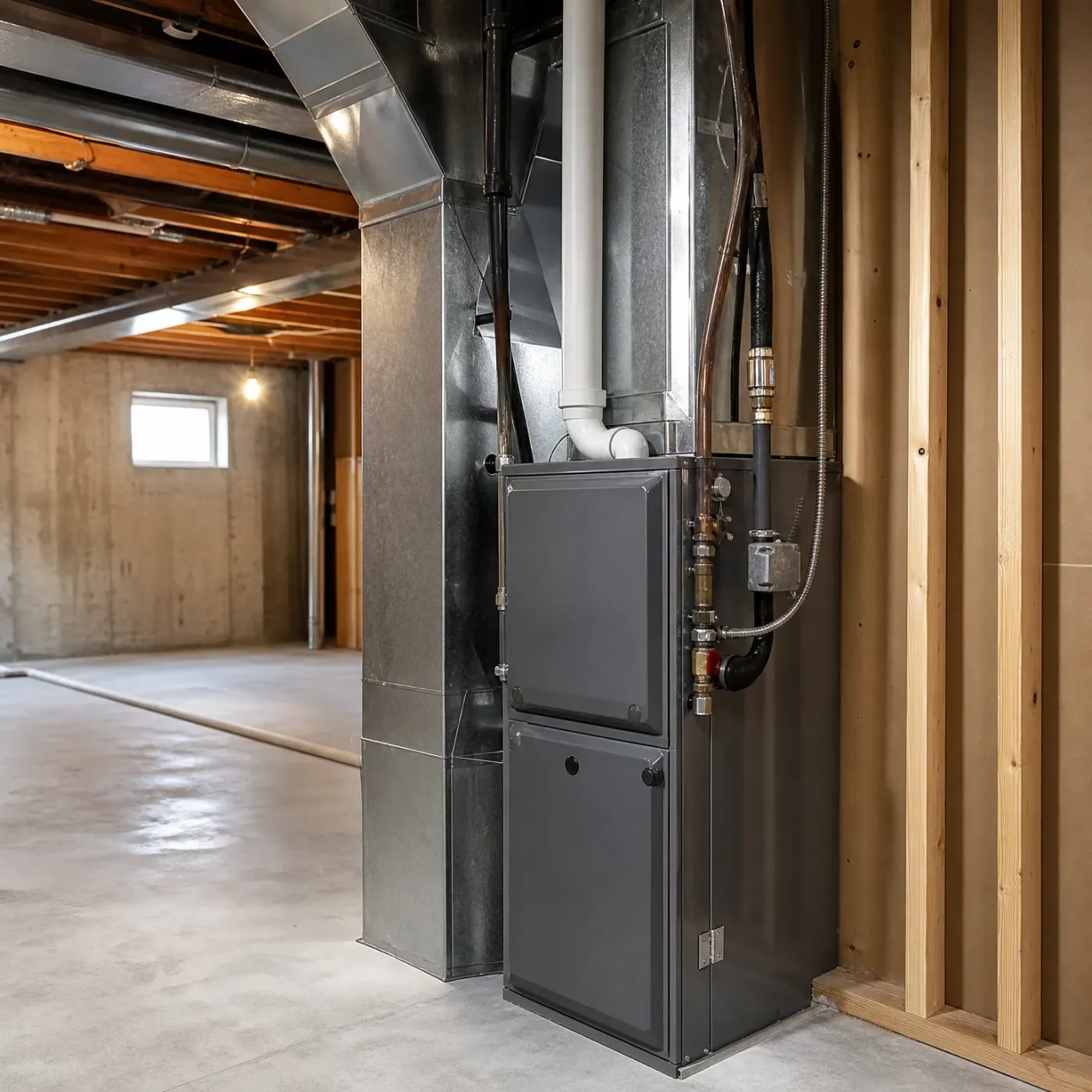
A gray high-efficiency furnace in a basement corner with white PVC vent pipes, copper and black gas piping, and sheet-metal ductwork beside a plain white wall and wooden stair framing.

Why the repair bills keep climbing

An old furnace doesn't fail all at once. The igniter goes, then a blower motor, then a pressure switch, each one a separate visit and a separate bill. Parts for a furnace that's 15 or 20 years old are also harder to find, since manufacturers stop stocking them once a model's been discontinued long enough. Every repair on a furnace that old is money spent on a machine that's still getting older underneath the fix.

Fix It Again or Replace It

Repair

  • A repair makes sense if the furnace is under 15 years old and the rest of it has held up fine.
  • A cracked heat exchanger is not repairable, so if that's the diagnosis, repair is off the table regardless of age.
  • If this is the first real problem it's had, fixing the igniter, the inducer motor, or a control board buys you more winters without a big outlay now.
  • Connecticut's electric rates make an inefficient system expensive to run, but a single repair doesn't change the furnace's efficiency rating.
  • A repair now doesn't rule out replacement later. It just means you're not ready to make that call yet.

Replace

  • Past 15 to 20 years, parts for that model get harder to find, and the ones you can get often cost more relative to a new system.
  • A new furnace carries a higher efficiency rating, which matters here given what Connecticut households pay for power.
  • If you've called a contractor out for the same furnace more than once in the last year or two, each repair is a bet that the next part won't fail too.
  • Replacing before a breakdown means you're choosing the timing, not scrambling to heat the house during a cold snap.
  • A new furnace comes with a warranty on parts and labor that an aging unit, patched repair by repair, doesn't have anymore.
A beige high-efficiency furnace stands on a concrete basement floor beside sheet-metal ductwork, with white PVC vent pipes and a gas line running along an insulated wood-framed wall.

Still doing its job

A furnace like this is holding up its end. The flue pipes, the gas line, the drain, all the connections are intact and the cabinet looks cared for. When a furnace is running clean like this, a repair is usually the right call.

An older metal furnace with a louvered front panel stands against a concrete basement wall, connected to sheet-metal ductwork and a flue pipe, with copper and steel pipes running alongside.

Showing its age

Dust on the cabinet and louvers like this isn't just cosmetic. It's a sign of a furnace that's been running hard for years without much attention. Past a certain age, every new noise or short cycle is worth weighing against the cost of another repair.


A woman wrapped in a cream textured blanket sits in an armchair beside a lit lamp and a dark window, with an open book in the foreground.
A bearded man in a plaid flannel shirt stands in a kitchen looking out a window toward snow-covered shrubs, with a steaming mug on the windowsill and potted plants on a shelf behind him.

An old furnace does not fail politely. It goes out on the coldest night of the year, when every other contractor's phone is already ringing, and you are the one stuck waiting.

Connecticut winters do not pause for that. Replacing it before it quits means you pick the day it happens, not the furnace.


A gray-haired, bearded man in a dark coat dusted with snow stands smiling in a dimly lit room with a lamp, mirror, framed art, and a sofa in the background.
An older man with white hair and a beard, wearing a dark snow-dusted coat and scarf, stands in a warmly lit interior hallway with a framed landscape picture, a table lamp and a potted plant behind him, and a snowy view through a window at left.
An older man in a dark snow-flecked overcoat and scarf stands smiling in a warmly lit home entryway, with a glass-paned door showing darkness outside and a lamp-lit room visible through a doorway behind him.
An older man with gray hair and a beard, wearing a dark snow-dusted jacket and scarf, stands smiling in a warmly lit interior hallway with a lit table lamp, a vase of dried branches, and a framed picture in the background.
A gray furnace with copper and flexible piping stands against a wood-framed wall in an unfinished basement, connected to galvanized sheet-metal ductwork and PVC venting, with a concrete floor and exposed joists.

Matched to your furnace job

Send it once and finding someone is no longer on you.

A local installer who puts in furnaces gets your project.

Hand off my installation

No charge to send it. You decide if you hire them.

What's your furnace telling you right now?

You might be hearing a boom when it kicks on, or a rattle from the cabinet that wasn't there last winter. Maybe it's running longer than it used to just to hit the thermostat setting, or cycling on and off more than it should. Some rooms upstairs stay cold no matter what you set it to. There might be a burnt smell the first few times it fires up in the fall, or soot around the access panel. If the pilot or igniter flame looks yellow instead of blue, that's not something to wait on. A furnace that's struggling to heat the house evenly or smells off when it runs is a furnace asking for a decision, not patience.


A gray high-efficiency furnace with white PVC vent pipes stands on a concrete pad in a basement, beside sheet-metal ductwork, copper piping and a poured concrete wall with wood framing at left.
Clean gas lines, solid venting, a cabinet that's been kept up. This furnace is worth fixing when something goes wrong.
A beige gas furnace in a basement with a metal flue pipe, galvanized sheet-metal ductwork to its left, and gas and water pipes along the concrete wall to its right.
A flue pipe and shutoff valves on an old unit that's been patched before. At some point another repair stops making sense.

Winter nights average 23°F statewide

23°F is the average overnight low here in December, January and February, and your furnace is what stands between that and the inside of your house. Every one of those nights, it has to run long enough to make up the difference. An older furnace working that hard has less room for error.

NOAA nClimDiv 1991-2020 county normals weighted by homes

An old furnace can still be worth fixing, or it can be past the point where another repair makes sense. The age, the heat exchanger, how it's been running, what it's cost you already this winter, all of that points one way or the other once you lay it out. Connecticut winters don't leave much room for a furnace that's on its way out, and the cold doesn't wait for a convenient week to make its move. If you've read this far and you're still not sure which side you're on, that's reason enough to get a second set of eyes on it. Send in what you know about your furnace and you'll be matched with a contractor who handles this kind of call all the time. Once that's sent, the work of figuring it out is off your plate. You don't have to decide alone whether it's the heat exchanger or just age catching up with the unit. Someone who looks at furnaces like yours every week can tell you straight, and you can stop turning it over in your head.

At dusk, a dark board-and-batten house with a standing-seam metal roof and lit entry walkway of stone pavers, with two large outdoor heat pump units on a stone-walled pad at right and trees and hills in the background.

Furnace Installation

A furnace pro near you

Step 1 of 3: Equipment
  • A corner of a room with an upholstered wood-framed armchair holding a floral pillow, a round side table with a ceramic lamp, books and a vase of greenery, a framed landscape painting on the wall, a patterned rug, and a sunlit multi-pane window.
    • A local pro who knows furnaces gets your details and gets in touch.
    • Describe your furnace job, and a local pro who handles it gets in touch.
  • Interior corner with a wood-framed window showing green foliage outside, a framed landscape print on a beige wall, and a rounded stone vase of leafy branches on a wooden cabinet.
    • One request ends the search for a furnace installer.
    • Once you send the form, finding a pro is off your list.
  • A pale ceramic vase holding olive branches sits on a dark wooden countertop beside a carved wooden dough bowl, next to a wood-framed window and a light painted plank wall.
    • Skip collecting and comparing quotes for the new furnace.
    • Skip the round of in-home estimates for a new furnace.
  • A dark wood round side table holding a brass lamp with a cream shade, a blue-and-white patterned bowl, and a white textured pot of greenery, beside an upholstered chair with a gray patterned cushion and a white-framed window showing green trees and flowering shrubs.
    • One installer gets your project, so there's no bidding war over it.
    • Your request goes to one pro, not a list of companies.