A local installer who puts in furnaces gets your project.
Furnace size isn't something you can eyeball from the box of the old one. Square footage matters, but so does your insulation, your windows, your ceiling height, and how much sun or shade your house gets in January. Connecticut winters push a furnace hard for months at a time, and a unit that's too big or too small shows it fast, either in your gas bill or in rooms that never quite warm up.
Too big and the furnace short cycles, turning on and off instead of running a steady, even heat. That wastes fuel and wears out parts sooner than it should. Too small and it runs flat out on the coldest nights and still can't keep up, while electric power here already costs more than in most of the country, so you feel every inefficiency on the bill.
Getting the number right takes someone standing in your house, not a formula typed into a search bar. A contractor who works on furnaces around Connecticut all winter has seen what your type of home typically needs and knows how to run a proper load calculation instead of guessing off square footage alone.
That's the point of what's below. You're matched with one licensed local contractor, not a handful of companies competing for your callback, and that contractor reaches out to you directly. Someone who already knows the kinds of furnaces that hold up in this climate, and who can walk your home and tell you what size actually fits it, not just what fits a chart.
No promises about what they'll find or what it'll cost to fix. Just a real person who does this work regularly in your area, looking at your actual house instead of a guess. The button below starts that.
There's no single furnace size for a Connecticut home. It comes down to a heat loss calculation, usually called a Manual J, that weighs your square footage against how well the house holds heat. A drafty older colonial with single-pane windows loses heat fast and needs more furnace per square foot than a tight, newer build with good insulation. Get the size wrong and you feel it either way. Too small, and the furnace runs nonstop through January and still can't keep the house at temperature on the coldest nights. Too big, and it short cycles, heating the house in quick bursts that leave rooms uneven and wear out the furnace faster than it should. A contractor who does this work in Connecticut homes regularly can run the calculation for your house specifically, instead of guessing from the old unit's label.
Sizing a furnace comes down to BTUs, the measure of heat output per hour, and matching that number to how much heat your house actually loses. A contractor works this out room by room, factoring in your windows, your insulation, your ceiling height, not just the square footage on file. Get it wrong one way and the furnace short cycles, switching on and off faster than it should, which wears on the heat exchanger over time and leaves some rooms colder than others. Get it wrong the other way and the furnace runs long stretches trying to catch up, especially during a hard cold snap, and still can't quite hold the thermostat setting. AFUE is a separate number from BTU size. It tells you how much of the fuel burned turns into heat inside the house rather than going out the flue, but it doesn't tell you whether the unit itself is the right output for your home. A contractor sizing a new furnace also looks at the ductwork, since ducts sized for one furnace can restrict or waste what a different size puts out.
How Sizing Actually Works
A Manual J calculation sizes a furnace by BTU output, weighing your square footage against your windows, insulation, and ceiling height, not by matching the old unit's rating.
An oversized furnace short cycles, switching on and off faster than it should, which wears the heat exchanger and leaves rooms unevenly heated.
An undersized furnace runs long stretches without reaching the thermostat setting, so it pushes hard through January cold snaps and still falls short.
Furnace output is rated in BTUs per hour, and that number has to match your home's actual heat loss, not just its square footage.
AFUE tells you how much of the fuel burned turns into heat inside the house, separate from whether the BTU size itself is correct.
A contractor doing a load calculation also checks duct sizing, since ducts built for one furnace size can choke or waste the output of another.
A furnace sized to your house runs long, steady cycles that keep rooms even and don't spike your electric bill.
A furnace sized wrong fights all winter, and rust and wear like this often show up alongside an undersized or aging unit.
Why does one room never get warm?
If the furnace is undersized, you'll notice it first in the room farthest from the thermostat, the one that stays chilly no matter how high you turn the heat. You might hear the furnace running almost nonstop on the coldest days, not cycling off like it should. An oversized one shows up differently: short bursts of heat, then quiet, then another burst, and the air feels uneven room to room. Either way, the furnace is working against the house instead of with it. Left alone through enough Connecticut winters, that strain adds up, on the furnace itself and on your electric bill, since power here isn't cheap to waste.
Furnace sized right
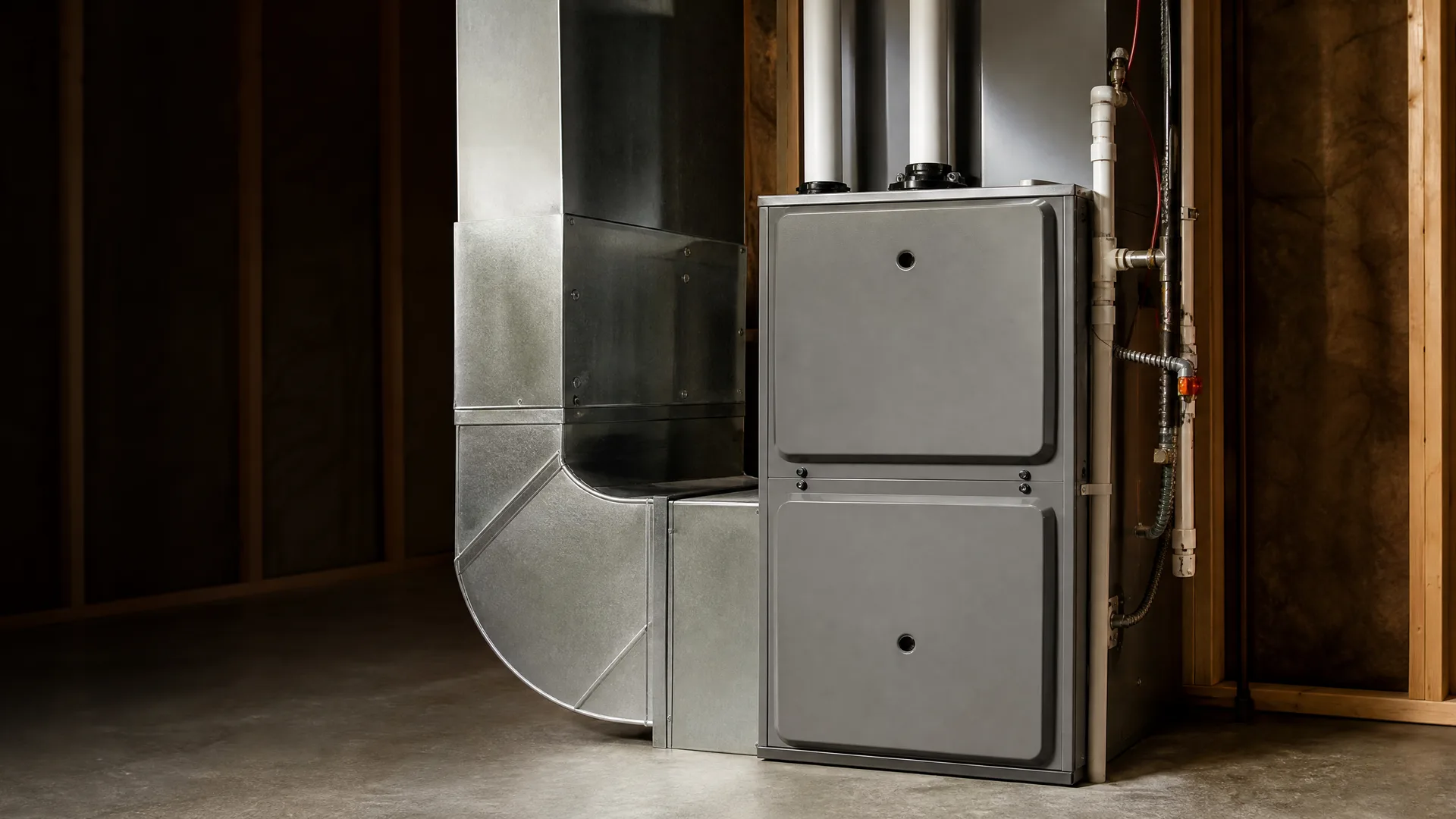
This furnace runs long, even cycles that keep the house warm without strain. The ductwork, gas lines, and vent pipes are sound, and the furnace isn't working harder than it has to on a cold January night. A correctly sized furnace keeps pace with the house, no matter how hard a Connecticut winter pushes it.
Furnace sized wrong
An older furnace like this one, undersized or oversized for the house, shows its strain over time. It may short cycle or run nearly nonstop trying to hold the temperature, and that wear shows up in the cabinet and the pipes around it. A furnace fighting the wrong load all winter doesn't hold up as well.
Getting the BTU number right matters more here than in most places, because Connecticut electric rates are among the highest in the country, and a furnace that's even a little off size runs that meter harder every cold month. The math behind a proper Manual J takes into account things you can't see from outside, how your particular house holds heat, where the sun hits it, what's behind the walls. A contractor who works on furnaces in Connecticut homes all winter has seen what tends to go wrong in houses like yours, whether that's an old colonial losing heat through single-pane windows or a newer build that was sized off the last furnace instead of the house itself. Submitting your details here connects you with one local contractor, not several competing for your attention, so the person who calls you back already has a sense of what you're dealing with before they walk in the door. If that cold room or the furnace running nonstop sounds familiar, it's worth having someone look at the actual numbers for your house.
A furnace one size up doesn't mean one size warmer. It cycles on, satisfies the thermostat near it in minutes, and shuts off before the heat reaches the far end of the house.
Those short cycles are when a heat exchanger takes the most stress, on and off dozens of times a day instead of running in long, even stretches through a January night.
Winter nights average 23°F statewide
23°F is a hard number for a furnace to meet night after night. A unit sized even a little wrong will run flat out trying to hold your rooms steady against that cold, and a Manual J is what tells an installer the BTU output your house actually needs to keep up.
NOAA nClimDiv 1991-2020 county normals weighted by homes
1
A contractor measures every room and window for the Manual J
2
The calculation weighs insulation, ceiling height, and air leaks against square footage
3
That math produces a BTU output number specific to your house
4
The installer matches a furnace to that number, not the old unit's rating
Before you get your furnace installationAfter you get your furnace installation
On a January night, your furnace isn't just holding steady, it's working against a statewide average of 23°F after dark, according to NOAA climate data for Connecticut. That's the number a furnace has to answer for hour after hour, not just on the coldest night of the year but most nights from December through February. A furnace sized right for your house will run a long, steady cycle to keep up with that cold and you won't notice much beyond the hum. One sized wrong either strains to catch up, leaving rooms cold toward morning, or short cycles and still can't hold the house even. Either way, you feel it at 2 a.m., not on the thermostat dial.
NOAA nClimDiv 1991-2020 county normals weighted by homes
How does a contractor actually calculate the right furnace size?
You've seen the term Manual J a few times now and you want to know what a contractor is actually doing with it, not just that it exists. If you're going to let someone size a furnace for your house, it helps to know what they measure and how those measurements turn into a BTU number instead of a guess.
Room by room measurements and a room by room heat loss number, added up
A contractor walks the house and measures every room, every window, and every exterior wall. Each one gets checked against its insulation and how much of it faces outside. That gives a heat loss number for that room alone, in BTUs per hour. Add up every room and you get the heat loss for the whole house. That total is the output the furnace has to match. It's not a formula tied to square footage by itself. A 1,800 square foot colonial with old single-pane windows can come out needing more BTUs than a newer house twice its size, because the math is counting what the house actually loses, not what it measures on a tape.
Set up right
This furnace ties into sheet-metal ductwork and PVC flue pipe with a clean gas line run. Sized to the house, it holds a steady cycle through a cold night instead of straining to catch up near the thermostat.
Set up wrong
This one sits on a pallet, still wired into the ductwork and condensate line above bare block walls. A furnace sized wrong for the house works harder than it should, and that strain shows up in the unit well before its time is up.
The right size comes from the math, not the model number on your old furnace
A Manual J gives you a BTU number built from your actual house, not a guess carried over from whatever was installed last time. That number is what holds your rooms steady on a 23°F night and what keeps the furnace from short cycling or running flat out trying to catch up.
Getting that number right is a job for someone who sizes furnaces in Connecticut houses all winter and knows how a drafty colonial differs from a tight newer build. Once you request a match, one licensed local contractor reaches out, not a handful competing for your attention, and they can walk through your house, your ductwork, and your windows before they land on a size.