Tell us about the job
Takes about a minute. No obligation.
A furnace repair in this area starts with the burner and heat exchanger, because those are the components that cycle hardest across a long heating season. Homes in Northeastern Connecticut Planning Region, CT run heat about eight months a year, from October through May. Ignition systems and heat exchangers accumulate stress through every start and stop, and a system that runs that deep into spring has little idle time to spare. When a contractor opens the unit, cracks in the heat exchanger or a worn igniter are common findings, and addressing them is what decides whether a repair is a minor fix or a full replacement.
Furnaces in houses this old have often been swapped, adapted, or retrofitted more than once, which means the unit a contractor opens bears little resemblance to what the original heating system looked like. Half the homes in Northeastern Connecticut Planning Region, Connecticut were built in 1973 or earlier (2020-2024 ACS 5-year). That depth of stock shapes what a repair call actually involves: heat exchangers cracked from decades of thermal cycling, burner assemblies running on components that manufacturers stopped producing years back, and flue configurations that were modified when a previous owner changed fuel sources. A contractor working here checks parts availability before quoting a repair, because a diagnosis that leads to an unfindable component turns a repair into a replacement conversation.
The Parts of a Furnace a Contractor Checks First
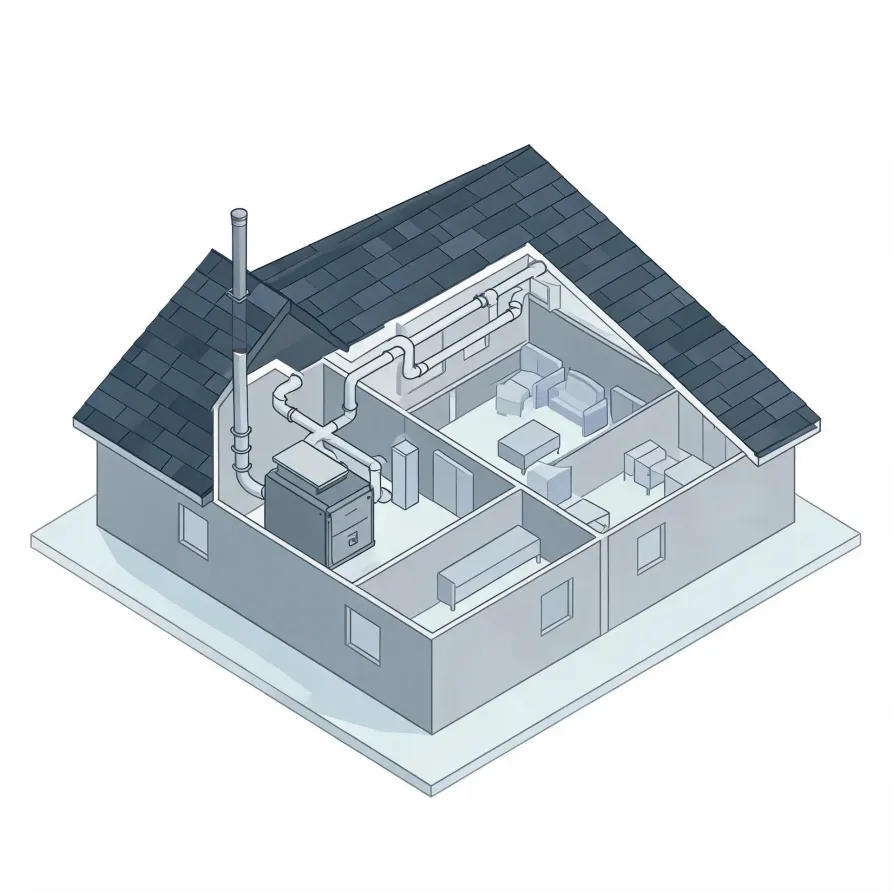
The furnace cabinet sits in a basement, utility room, or closet and is the core of the system. Inside it, the heat exchanger is where combustion heat transfers to your air, and a cracked or corroded exchanger is one of the first things a contractor looks at when the system is running poorly or throwing a fault code. The burners sit directly below it and are checked for uneven flame, buildup, or failure to light.
The blower motor and its wheel sit at the base of the cabinet and push conditioned air out through the supply side. The inducer motor pulls combustion gases toward the flue and runs just before ignition. The control board ties everything together, reading signals from the thermostat and firing each component in sequence. When any part of that sequence breaks down, the board is where a contractor reads the fault.
The drawing shows a representative furnace layout, and a licensed contractor determines which components apply to your specific equipment and installation.
Find a contractor in Northeastern Connecticut Planning RegionNortheastern Connecticut Planning Region by the Numbers
Half the homes in Northeastern Connecticut Planning Region, Connecticut were built in 1973 or earlier (2020-2024 ACS 5-year).
U.S. Census Bureau, 2020-2024 American Community Survey 5-Year EstimatesNortheastern Connecticut Planning Region, Connecticut holds 41,736 housing units (2020-2024 ACS 5-year).
U.S. Census Bureau, 2020-2024 American Community Survey 5-Year EstimatesOwners occupy 77.3% of the occupied homes in Northeastern Connecticut Planning Region, Connecticut (2020-2024 ACS 5-year).
U.S. Census Bureau, 2020-2024 American Community Survey 5-Year EstimatesFurnace Repair Rules & Codes for Northeastern Connecticut Planning Region, Connecticut5 sourced standards and regulations
What HVAC Repair Looks Like in Northeastern Connecticut
Non-weatherized gas furnaces manufactured on or after November 19, 2015 must reach 80.0 percent AFUE.
Non-weatherized oil-fired furnaces manufactured on or after November 19, 2015 must reach 83.0 percent AFUE.
Mobile home gas furnaces manufactured on or after November 19, 2015 must reach 80.0 percent AFUE.
Non-weatherized gas furnaces manufactured on or after December 18, 2028 must reach 95.0 percent AFUE, up from the 80.0 percent minimum that applies to units manufactured before that date.
Licensing Rules for HVAC Repair in Northeastern Connecticut Planning Region, Connecticut
Connecticut requires a state licence to perform, or to advertise, heating, piping and cooling work: no person may practise an occupation this chapter covers without first obtaining one.