Tell us about the job
Takes about a minute. No obligation.
Burner cycles and heat exchanger stress are where a furnace repair in Lower Connecticut River Valley tends to start. Homes in Lower Connecticut River Valley Planning Region, CT run heat about eight months a year, from October through May. A furnace that has been firing and cooling through that kind of calendar accumulates wear on its ignition system, its heat exchanger seams, and the burner itself before any other part shows strain. When a contractor opens a unit here and finds a cracked exchanger or a degraded igniter, the season's load is the likely cause, and those are the components a thorough diagnosis prices first.
Furnaces running in houses this old were specified and installed for a different era of components entirely. Half the homes in Lower Connecticut River Valley Planning Region, Connecticut were built in 1972 or earlier (2020-2024 ACS 5-year). A contractor who opens a system here checks not just what failed, but whether the replacement part still has a supply chain behind it. When it does not, a repair that would otherwise be simple becomes a sourcing problem first, and the scope of the job shifts before any wrench turns.
The Parts of a Furnace a Contractor Checks First
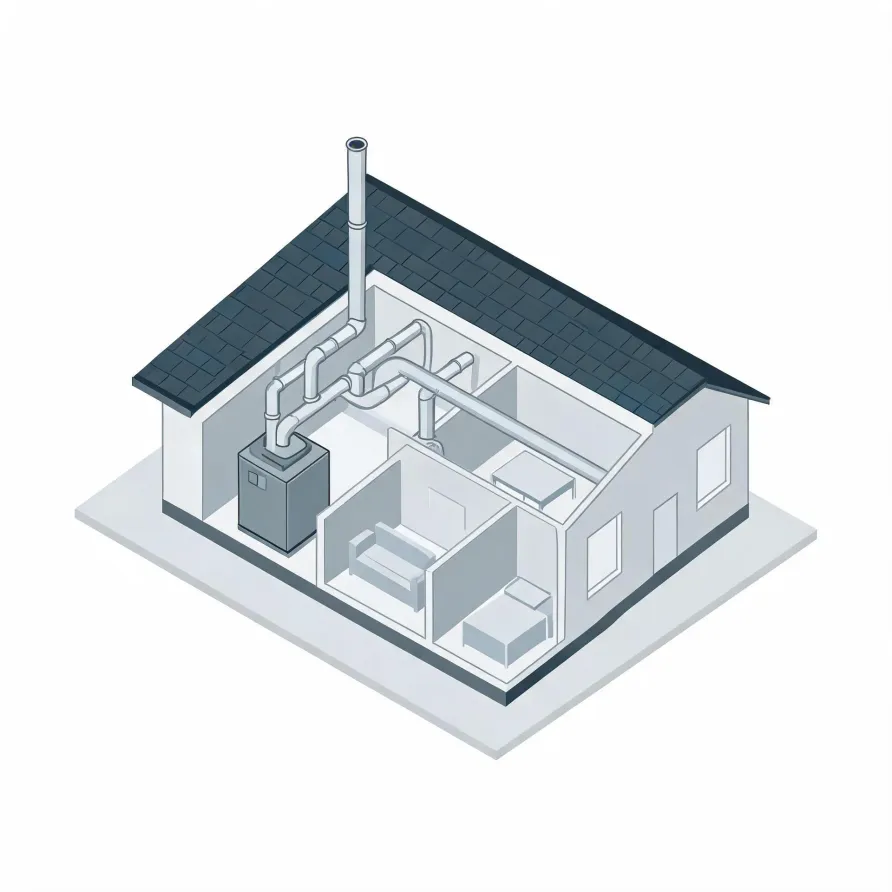
The furnace itself sits in a mechanical room, basement, or utility closet and is the piece a contractor goes to first. Inside it, the heat exchanger is the part that matters most when something is wrong: cracks or failures there are what stop the system from doing its job safely. The burners, which fire inside that exchanger, are the next place a contractor looks when heat output drops or the unit short-cycles.
The blower motor sits at the base of the furnace cabinet and pushes conditioned air into the duct system. Alongside it, the flue pipe runs from the top of the furnace up and out of the house, carrying combustion gases away. The control board and the igniter are both housed inside the cabinet and are common points of failure when the furnace runs erratically or won't start.
The drawing shows a representative layout, and a licensed contractor determines which components apply to your specific system and installation.
Find a contractor in Lower Connecticut River Valley Planning RegionLower Connecticut River Valley Planning Region, by the numbers
Half the homes in Lower Connecticut River Valley Planning Region, Connecticut were built in 1972 or earlier (2020-2024 ACS 5-year).
U.S. Census Bureau, 2020-2024 American Community Survey 5-Year EstimatesLower Connecticut River Valley Planning Region, Connecticut holds 82,963 housing units (2020-2024 ACS 5-year).
U.S. Census Bureau, 2020-2024 American Community Survey 5-Year EstimatesOwners occupy 75.8% of the occupied homes in Lower Connecticut River Valley Planning Region, Connecticut (2020-2024 ACS 5-year).
U.S. Census Bureau, 2020-2024 American Community Survey 5-Year EstimatesCodes & Standards Behind Furnace Repair in Lower Connecticut River Valley Planning Region, Connecticut5 sourced rules and standards
What happens when a contractor comes out for HVAC repair
Non-weatherized gas furnaces manufactured on or after November 19, 2015 must reach 80.0 percent AFUE.
Non-weatherized oil-fired furnaces manufactured on or after November 19, 2015 must reach 83.0 percent AFUE.
Mobile home gas furnaces manufactured on or after November 19, 2015 must reach 80.0 percent AFUE.
Non-weatherized gas furnaces manufactured on or after December 18, 2028 must reach 95.0 percent AFUE, up from the 80.0 percent minimum that applies to units manufactured before that date.
Licensing Rules for HVAC Repair in Lower Connecticut River Valley Planning Region, Connecticut
Connecticut requires a state licence to perform, or to advertise, heating, piping and cooling work: no person may practise an occupation this chapter covers without first obtaining one.