Tell us about the job
Takes about a minute. No obligation.
A furnace repair in Northwest Hills starts with the parts that cycle hardest: the burner, the heat exchanger, and the ignition system. Homes in Northwest Hills Planning Region, CT run heat about eight months a year, from October through May. That runtime accumulates in metal that expands and contracts every time the burner fires, and cracks in a heat exchanger or a worn igniter are the faults a contractor finds most often here. A unit that was undersized at installation shows that wear earlier than the nameplate would suggest.
Half the homes in Northwest Hills Planning Region, Connecticut were built in 1967 or earlier (2020-2024 ACS 5-year). A house built by that point was wired and ducted for equipment that looks nothing like what a contractor opens today, and each replacement since has asked more of the original infrastructure. When a furnace comes apart for repair, what the technician finds inside often reflects that layered history: heat exchangers that have been pushed harder than rated, controls substituted across product generations, and wiring that was extended rather than replaced. Parts for a system in stock like this are not always still in production, which changes what a repair costs and whether a like-for-like fix is even available.
The Parts of a Furnace a Contractor Checks First
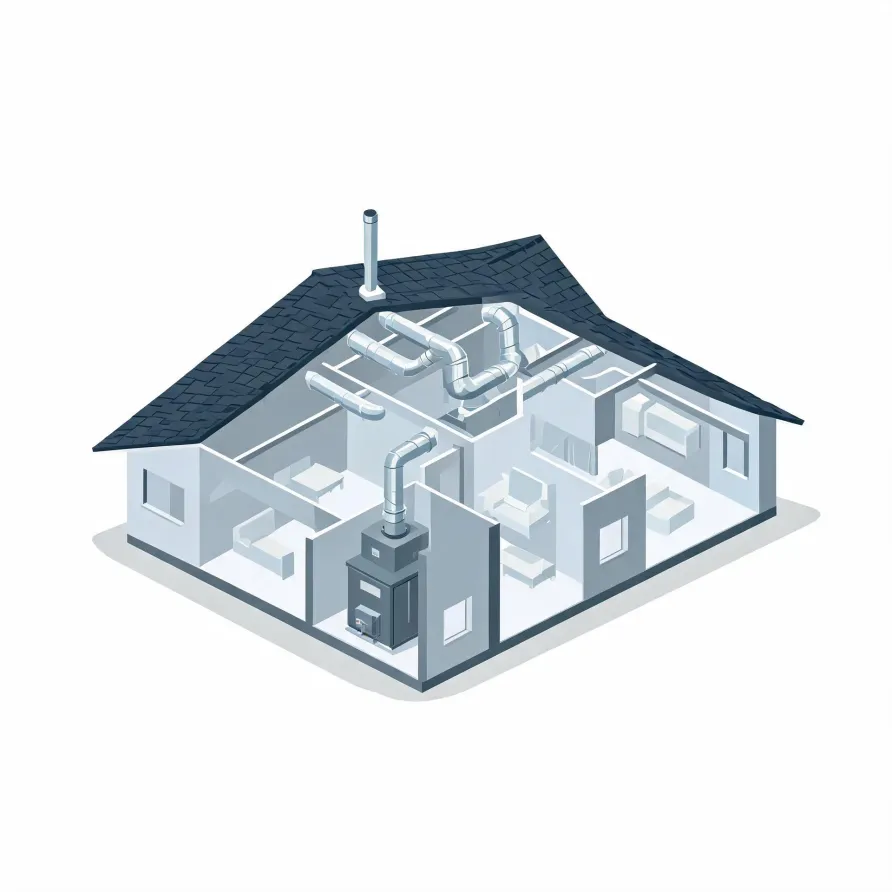
The furnace itself sits in a utility space, basement, or closet and is the piece a contractor opens first. Inside it, the heat exchanger and burner assembly are the main suspects when heat is absent or uneven. A cracked heat exchanger or a failed igniter will stop the system cold, and both are examined before anything else.
The blower motor sits inside the furnace cabinet and pushes conditioned air out through the supply side of the house. The flue pipe runs from the unit to an exterior wall or roof and carries combustion gases out. The thermostat, mounted on a wall inside the living space, tells the whole system when to run, and a fault there can look exactly like a furnace problem.
The drawing shows a typical layout, and a licensed contractor determines which components apply to your specific system and home.
Find a contractor in Northwest Hills Planning RegionNorthwest Hills by the Numbers
Half the homes in Northwest Hills Planning Region, Connecticut were built in 1967 or earlier (2020-2024 ACS 5-year).
U.S. Census Bureau, 2020-2024 American Community Survey 5-Year EstimatesNorthwest Hills Planning Region, Connecticut holds 55,752 housing units (2020-2024 ACS 5-year).
U.S. Census Bureau, 2020-2024 American Community Survey 5-Year EstimatesOwners occupy 76.3% of the occupied homes in Northwest Hills Planning Region, Connecticut (2020-2024 ACS 5-year).
U.S. Census Bureau, 2020-2024 American Community Survey 5-Year EstimatesFurnace Repair Rules & Standards in Northwest Hills Planning Region, Connecticut5 codes, laws, and standards
What HVAC Repair Looks Like in Northwest Hills
Non-weatherized gas furnaces manufactured on or after November 19, 2015 must reach 80.0 percent AFUE.
Non-weatherized oil-fired furnaces manufactured on or after November 19, 2015 must reach 83.0 percent AFUE.
Mobile home gas furnaces manufactured on or after November 19, 2015 must reach 80.0 percent AFUE.
Non-weatherized gas furnaces manufactured on or after December 18, 2028 must reach 95.0 percent AFUE, up from the 80.0 percent minimum that applies to units manufactured before that date.
Licensing Rules for HVAC Repair in Northwest Hills Planning Region, Connecticut
Connecticut requires a state licence to perform, or to advertise, heating, piping and cooling work: no person may practise an occupation this chapter covers without first obtaining one.