Tell us about the job
Takes about a minute. No obligation.
A furnace repair in Naugatuck Valley starts before the contractor opens anything up. Homes in Naugatuck Valley Planning Region, CT run heat about eight months a year, from October through May. Burners and heat exchangers cycle on and off across that run, and the ignition system takes a stress hit every single time. A contractor diagnosing a failure here checks those parts first because the wear pattern points there before it points anywhere else. Cracks in a heat exchanger and igniter degradation both trace directly to accumulated cycling, and a quote that skips that inspection is pricing the wrong thing.
Ductwork sized and sealed for original equipment carries the full load of what a technician finds once the furnace is open: a heat exchanger that has cycled through more heating seasons than most current parts catalogs account for, and burner components whose wear pattern reflects sustained use rather than a single failure. Half the homes in Naugatuck Valley Planning Region, Connecticut were built in 1969 or earlier (2020-2024 ACS 5-year). That history changes what a repair involves. A contractor opening a furnace in stock like this checks the exchanger for fatigue before pricing anything else, because a cracked exchanger reframes the whole job. Parts availability is a real variable at this end of the age range, and it shapes both what gets ordered and what gets recommended instead.
The Parts of a Furnace a Contractor Checks First
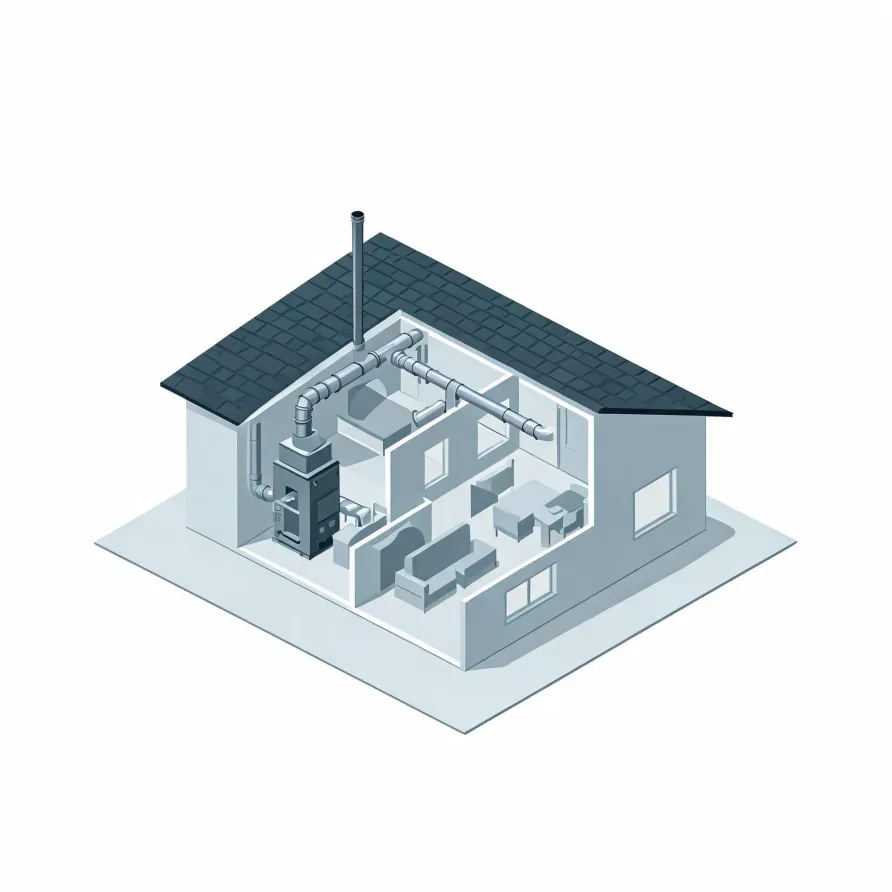
The furnace itself sits in the basement, utility room, or closet and is the piece a contractor goes to first. Inside it, the heat exchanger is the part that warms the air, and a crack or failure there is what stops heat from reaching the rest of the house. The burners, igniter, and flame sensor sit within the same cabinet and are the usual suspects when the unit runs but produces no heat.
The blower motor and its fan wheel push conditioned air out through the supply side and are what a contractor checks when airflow feels weak or uneven. The flue pipe runs from the top or back of the furnace to an outside vent, and a blockage or breach there is a problem a contractor looks for early. The thermostat, mounted on a wall inside the living space, tells the furnace when to fire and is often the first thing a contractor tests before opening the cabinet.
The drawing shows the general layout of a furnace system, and a licensed contractor determines which parts apply to the specific setup in your house.
Find a contractor in Naugatuck Valley Planning RegionNaugatuck Valley by the Numbers
Half the homes in Naugatuck Valley Planning Region, Connecticut were built in 1969 or earlier (2020-2024 ACS 5-year).
U.S. Census Bureau, 2020-2024 American Community Survey 5-Year EstimatesNaugatuck Valley Planning Region, Connecticut holds 192,551 housing units (2020-2024 ACS 5-year).
U.S. Census Bureau, 2020-2024 American Community Survey 5-Year EstimatesOwners occupy 68.6% of the occupied homes in Naugatuck Valley Planning Region, Connecticut (2020-2024 ACS 5-year).
U.S. Census Bureau, 2020-2024 American Community Survey 5-Year EstimatesFurnace Repair Rules on Record for Naugatuck Valley Planning Region, Connecticut5 codes, standards & citations
What HVAC Repair Looks Like in Naugatuck Valley
Non-weatherized gas furnaces manufactured on or after November 19, 2015 must reach 80.0 percent AFUE.
Non-weatherized oil-fired furnaces manufactured on or after November 19, 2015 must reach 83.0 percent AFUE.
Mobile home gas furnaces manufactured on or after November 19, 2015 must reach 80.0 percent AFUE.
Non-weatherized gas furnaces manufactured on or after December 18, 2028 must reach 95.0 percent AFUE, up from the 80.0 percent minimum that applies to units manufactured before that date.
Licensing Rules for HVAC Work in Naugatuck Valley Planning Region, Connecticut
Connecticut requires a state licence to perform, or to advertise, heating, piping and cooling work: no person may practise an occupation this chapter covers without first obtaining one.